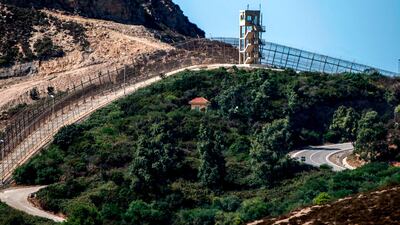
A guard tower overlooking the border fence encircling Spain's North African enclave of Ceuta, which lies on the Strait of Gibraltar, surrounded by Morocco. AFP
The reopening will start gradually from May 17, Spanish Interior Minister Fernando Grande-Marlaska told reporters on Thursday.
Crossings will be initially limited to residents of Europe's passport-free Schengen area and their family members. They will be expanded to cross-border workers by the end of the month.
The Spanish enclaves of Ceuta and Melilla sit on the northern shores of Morocco's Mediterranean coast. Together they form the EU's only land borders with Africa.
Thursday's announcement came as Madrid and Rabat are working to mend relations after a months-long spat, mainly over migrants coming from Morocco.
The two cities have long been a flashpoint in the diplomatic relations between both countries.
Madrid asserts that both territories are integral parts of Spain. The two cities were granted self-government and regarded autonomous in 1995.
Tensions soared in the summer of last year after thousands of migrants crossed into Ceuta from Morocco through land borders and the city’s main maritime entry point in the south. Spain then deployed troops to restore order and sent back a large number of migrants to Morocco.
The European country says it will deal firmly with illegal crossings and crack down on people smuggling gangs.
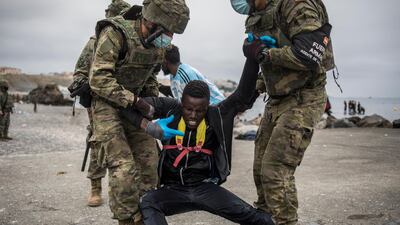
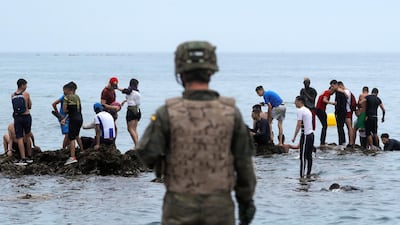
A man is held by soldiers of the Spanish Army at the border of Morocco and Spain at the Spanish enclave of Ceuta. A record 6,000 migrants entered Ceuta illegally on Monday, 1,500 of whom were minors. AP Photo
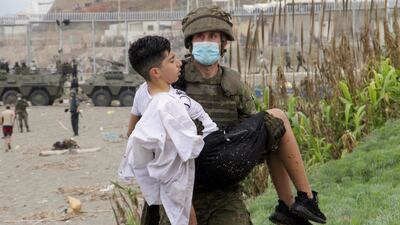
A Spanish soldier helps a migrant as troops are deployed along the coast in Ceuta. EPA
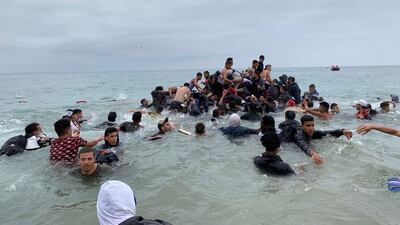
Migrants manage to grab onto a boat of the Moroccan authorities near the coast of Fnideq in an attempt to cross over to Ceuta. EPA
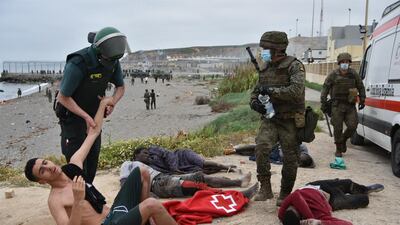
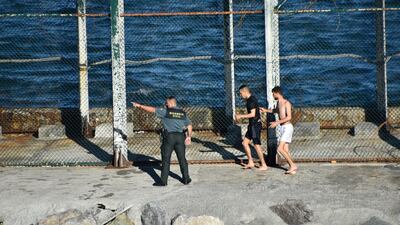
A Spanish Civil Guard holds onto a migrant who swam onto the Spanish enclave of Ceuta. AFP
A Spanish soldier stands in front of Moroccan migrants. Reuters
Red Cross members and Spanish soldiers carry a migrant into an ambulance. AFP
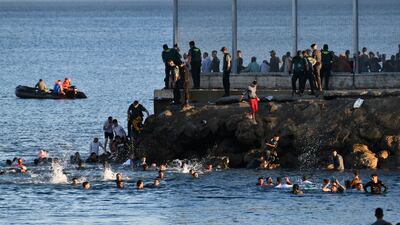
Spanish officers try to stop people swimming into Spanish territory at Ceuta. AP Photo
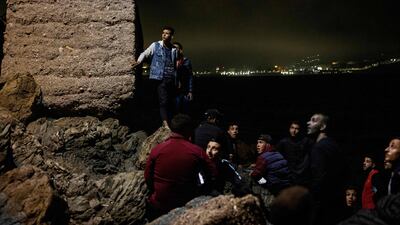
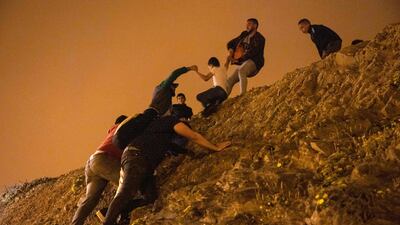
Moroccan migrants climb up a rocky cliffside in the northern town of Fnideq as they attempt to cross the border from Morocco to Ceuta. AFP
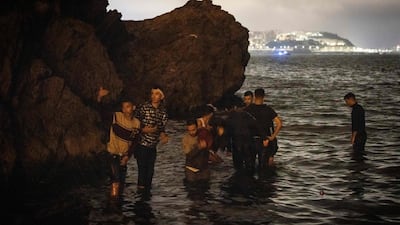
Moroccan migrants walk into shallow waters in the northern town of Fnideq. AFP
Two migrants are met by a Spanish civil guard in Ceuta. Reuters
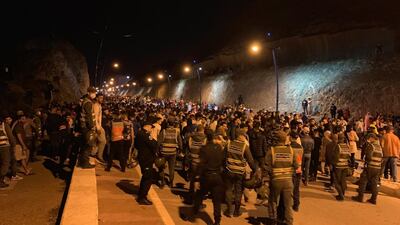
Hundreds of young Moroccans wait to cross the border with Spain. EPA
About 3,000 Moroccan citizens illegally entered Spain's north African enclave of Ceuta. AFP
Spain says it will return anyone from the country who illegally enters its north African enclave by water. AFP
Before the pandemic, Ceuta and Melilla used to attract traders and workers as local economics depend on the cross-border movement of goods. Most of the migrants are said to be from Morocco.
Spain’s decision to open the borders of Ceuta and Melilla with Morocco also comes after signs of a thaw in relations over Western Sarah, a former Spanish colony claimed by Morocco in 1976.
On March 18, the Spanish government announced publicly and for the first time its support to a 2007 initiative taken by Morocco to grant the disputed Western Sarah autonomy.
It described the Moroccan plan as the “serious and credible” effort taken so far to resolve the dispute.
That decision was a reversal of Spain’s longstanding position of neutrality on the region, a sparsely populated desert area situated on the northwest coast of Africa.
Moroccan King Mohammed VI, centre, with Spain's Prime Minister Pedro Sanchez, second left, Crown Prince Moulay Hassan, second right, Prince Moulay Rachid, the king's brother, right, and Morocco's Prime Minister Aziz Akhannouch, left, before an Iftar meal at the King Royal residence in Sale, Morocco, in April 7. Royal Palace/AP
Morocco’s King Mohammed VI decided then to send back the Moroccan ambassador to Spain 10 months after she was recalled and hosting Spanish Prime Minister Pedro Sanchez in an April visit to Rabat.
Morocco administers around 80 per cent of the 266,000 square kilometres of the sparsely populated desert region with the remainder held by the Algerian supported the self-declared Sahrawi Arab Republic founded by the Polisario Front.
The Polisario waged a guerrilla war against Moroccan troops until a UN-brokered ceasefire in 1991.
Rabat is offering to grant Western Sahara autonomy, while Polisario is demanding a referendum on full independence.
The breakaway state is not recognised by the UN and Morocco’s claim to the region is supported by a number of Arab and African states.

Term life insurance: this is the cheapest and most-popular form of life cover. You pay a regular monthly premium for a pre-agreed period, typically anything between five and 25 years, or possibly longer. If you die within that time, the policy will pay a cash lump sum, which is typically tax-free even outside the UAE. If you die after the policy ends, you do not get anything in return. There is no cash-in value at any time. Once you stop paying premiums, cover stops.
Whole-of-life insurance: as its name suggests, this type of life cover is designed to run for the rest of your life. You pay regular monthly premiums and in return, get a guaranteed cash lump sum whenever you die. As a result, premiums are typically much higher than one term life insurance, although they do not usually increase with age. In some cases, you have to keep up premiums for as long as you live, although there may be a cut-off period, say, at age 80 but it can go as high as 95. There are penalties if you don’t last the course and you may get a lot less than you paid in.
Critical illness cover: this pays a cash lump sum if you suffer from a serious illness such as cancer, heart disease or stroke. Some policies cover as many as 50 different illnesses, although cancer triggers by far the most claims. The payout is designed to cover major financial responsibilities such as a mortgage or children’s education fees if you fall ill and are unable to work. It is cost effective to combine it with life insurance, with the policy paying out once if you either die or suffer a serious illness.
Income protection: this pays a replacement income if you fall ill and are unable to continue working. On the best policies, this will continue either until you recover, or reach retirement age. Unlike critical illness cover, policies will typically pay out for stress and musculoskeletal problems such as back trouble.
Wicked: For Good
Director: Jon M Chu
Starring: Ariana Grande, Cynthia Erivo, Jonathan Bailey, Jeff Goldblum, Michelle Yeoh, Ethan Slater
Founder of the Muslim Brotherhood, Hassan al Banna, "accepted the political utility of violence"
Views of key Muslim Brotherhood ideologue, Sayyid Qutb, have “consistently been understood” as permitting “the use of extreme violence in the pursuit of the perfect Islamic society” and “never been institutionally disowned” by the movement.
Muslim Brotherhood at all levels has repeatedly defended Hamas attacks against Israel, including the use of suicide bombers and the killing of civilians.
Laying out the report in the House of Commons, David Cameron told MPs: "The main findings of the review support the conclusion that membership of, association with, or influence by the Muslim Brotherhood should be considered as a possible indicator of extremism."
UAE squad: Rohan Mustafa (captain), Shaiman Anwar, Ghulam Shabber, Mohammed Qasim, Rameez Shahzad, Mohammed Usman, Adnan Mufti, Chirag Suri, Ahmed Raza, Imran Haider, Mohammed Naveed, Amjad Javed, Zahoor Khan, Qadeer Ahmed Fixtures and results:
Monday, UAE won by three wickets
Wednesday, 2nd 50-over match
Thursday, 3rd 50-over match
Indoor Cricket World Cup
Venue Insportz, Dubai, September 16-23
UAE squad Saqib Nazir (captain), Aaqib Malik, Fahad Al Hashmi, Isuru Umesh, Nadir Hussain, Sachin Talwar, Nashwan Nasir, Prashath Kumara, Ramveer Rai, Sameer Nayyak, Umar Shah, Vikrant Shetty
1980 Ruwais Housing Complex built, located 10 kilometres away from industrial plants
1982 120,000 bpd capacity Ruwais refinery complex officially inaugurated by the founder of the UAE Sheikh Zayed
1984 Second phase of Ruwais Housing Complex built. Today the 7,000-unit complex houses some 24,000 people.
1985 The refinery is expanded with the commissioning of a 27,000 b/d hydro cracker complex
2009 Plans announced to build $1.2 billion fertilizer plant in Ruwais, producing urea
2010 Adnoc awards $10bn contracts for expansion of Ruwais refinery, to double capacity from 415,000 bpd
2014 Ruwais 261-outlet shopping mall opens
2014 Production starts at newly expanded Ruwais refinery, providing jet fuel and diesel and allowing the UAE to be self-sufficient for petrol supplies
2014 Etihad Rail begins transportation of sulphur from Shah and Habshan to Ruwais for export
2017 Aldar Academies to operate Adnoc’s schools including in Ruwais from September. Eight schools operate in total within the housing complex.
2018 Adnoc announces plans to invest $3.1 billion on upgrading its Ruwais refinery
2018 NMC Healthcare selected to manage operations of Ruwais Hospital
2018 Adnoc announces new downstream strategy at event in Abu Dhabi on May 13
Source: The National
What vitamins do we know are beneficial for living in the UAE
Vitamin D: Highly relevant in the UAE due to limited sun exposure; supports bone health, immunity and mood. Vitamin B12: Important for nerve health and energy production, especially for vegetarians, vegans and individuals with absorption issues. Iron: Useful only when deficiency or anaemia is confirmed; helps reduce fatigue and support immunity. Omega-3 (EPA/DHA): Supports heart health and reduces inflammation, especially for those who consume little fish.